By Deepika Negi, Founder and CEO, BizareXpedition
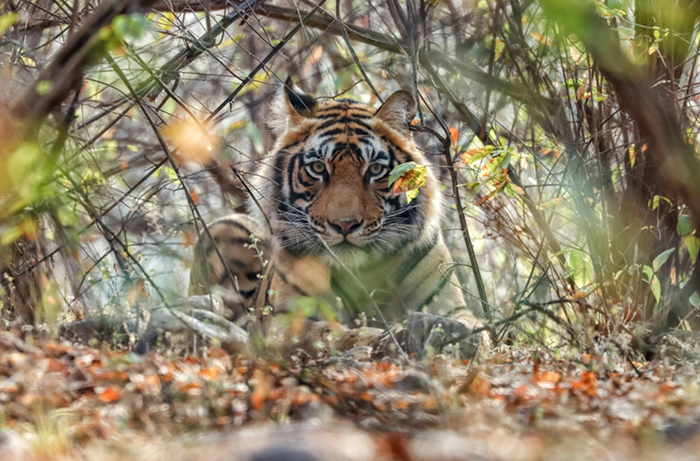
The forest hadn’t decided about the light yet when our jeep crossed into Bandhavgarh’s Tala zone. Sal trees stood grey and patient in the mist, and the only sound for a long, held minute was the tick of a cooling engine and, somewhere behind a stand of bamboo, an alarm call that hadn’t quite finished vibrating in the air. There was no second jeep jostling for the same sightline. No phone held up. No queue of engines idling at five hundred metres, then four hundred, then closer. Just the forest working out its own morning on its own time.
Bandhavgarh takes its name from two words – Bandhav, meaning brother, and Garh, meaning fort, after the Ramayana’s account of Lord Rama gifting the hilltop citadel above the park to his brother, Lakshman, so that he might keep watch over Lanka. The fort still stands over the Tala zone today, more than two thousand years old by most estimates, its ruined ramparts visible from the safari track. Long before it was a national park, Bandhavgarh was a shikargah (a private hunting ground) of the Baghel kings of Rewa, who guarded its forests jealously for much the same reason today’s traveller now seeks them out: because they were untouched, and because access to them was earned, not simply bought at a gate.
Ranthambore has become India’s favourite single-origin chocolate bar – rich, famous, and now broken into smaller and smaller squares for everyone who wants a piece. Madhya Pradesh is the full tasting menu next door that nobody has ordered yet.
In February this year, a video from Ranthambore’s Mishri Darra gate went viral for exactly the wrong reasons: ten jeeps converging on a single tiger within three minutes of a sighting, engines running, phones raised, the animal visibly boxed in on all sides. It was not an isolated lapse. Guides now coordinate sightings live over the phone, and the park’s own geography compounds the problem. Ranthambore holds its tigers within just 1,411 square kilometres, making it, by most counts, the third most crowded tiger reserve in the country after Corbett and Kaziranga. The park responded at the end of January by banning mobile phones on safari altogether, in line with Supreme Court and National Tiger Conservation Authority directives. It was the right call. It was also, unmistakably, a symptom.
Madhya Pradesh has never had to make that call, because it never ran out of room. The state carries nine tiger reserves: Kanha, Bandhavgarh, Pench, Satpura, Panna, Sanjay-Dubri, Ratapani, Veerangana Durgavati and the newly notified Madhav, more than any other state in the country. By the last All India Tiger Estimation, it also holds more tigers than any other state: 785 of them, up exactly fifty per cent on the 526 recorded just four years earlier, and well ahead of Karnataka’s 563 and Uttarakhand’s 560. Bandhavgarh alone carries 135, Kanha 105, Pench 77 – individually competitive with Ranthambore’s own count of under ninety, yet the maths behind them tells the real story. Bandhavgarh’s reserve spans 1,537 square kilometres, Kanha’s a further 2,052, and Pench’s, on the Madhya Pradesh side, another 1,180 – together, more than 4,750 square kilometres of protected forest between just three parks, over three times the 1,411 square kilometres Ranthambore has to work with. Even inside Bandhavgarh, the crowding is a local problem, not a park-wide one: almost every jeep concentrates in the Tala zone, while Magadhi and Khitauli, its two other zones, see a fraction of the traffic for comparable sightings. Kanha’s grasslands, meanwhile, run for kilometres in every direction, and Pench straddles the Madhya Pradesh-Maharashtra border in teak and bamboo thick enough to absorb a dozen jeeps without anyone noticing another was ever there.
Where the Tigers Actually Are
| Reserve | Estimated Tiger Count (2022 All India Tiger Estimation) |
| Bandhavgarh (MP) | 135 |
| Kanha (MP) | 105 |
| Pench (MP) | 77 |
| Ranthambore (Rajasthan), 1,411 sq km | 69 |
Note: Madhya Pradesh holds 785 tigers statewide across 9 reserves, more than any other Indian state. Source: NTCA / All India Tiger Estimation
And Madhya Pradesh’s wild census, these days, no longer stops at tigers. At Kuno National Park in Sheopur, the site of the world’s first intercontinental big cat translocation, the state now holds 57 free-ranging and boma-conditioned cheetahs, the largest wild cheetah population found anywhere outside Africa. Of those, 54 live at Kuno itself – 17 now free-ranging across its open grassland, the rest still in the large fenced soft bomas used to condition each new arrival before release, and the remaining three at a second site, Gandhi Sagar Wildlife Sanctuary in Mandsaur, which began receiving its own translocated cats only in 2024. It is a strange and thrilling fact that most Indian travellers still don’t know: that seventy years after the cheetah went extinct on this soil, it is Madhya Pradesh’s grasslands, not Africa’s, where the species’ comeback is now quietly being written.
Panna’s story is the wildlife equivalent of a soufflé that collapsed completely and was coaxed, patiently, back into shape.
Panna deserves its own paragraph. In 2009, poaching wiped out every single tiger in the reserve, a total, humiliating zero, the kind of collapse that ends most conservation stories for good. Instead, forest officials brought in one male from Pench and two tigresses from Bandhavgarh and Kanha, and rebuilt the population from that seed. Today Panna holds more than 60 tigers, alongside one of India’s most successful barasingha reintroduction programmes; the swamp deer that is Madhya Pradesh’s state animal, whose numbers state-wide have climbed from under 100 to more than 1,000. It remains one of the least visited of the state’s major reserves, which is, in its own quiet way, precisely the appeal: a comeback story you can watch unfold in near-total privacy.
None of this has gone unnoticed by the numbers. Madhya Pradesh drew 134.1 million tourists of every kind in 2024, up 19.6 per cent on the year before, and its 1.67 lakh foreign arrivals state-wide are increasingly choosing the forests over the temples. Bandhavgarh alone logged 29,192 international visitors that year on top of the roughly 176,000 total visitors, domestic and foreign combined, the park was already recording annually even before this latest surge ahead of Kanha’s 19,148, Panna’s 12,762 and Pench’s 11,272. The state’s new Tourism Policy has put capital grants of up to ₹90 crore behind larger hospitality investments, and a helicopter service, the PM Shri Heli Paryatan Sewa, now links Kanha, Bandhavgarh, Khajuraho and Panna directly, folding what used to be a day of road travel between reserves into a single hop. Quietly, and without the crowding problems now dogging Rajasthan’s most famous park, Madhya Pradesh has built the infrastructure to be India’s next serious wildlife circuit, not merely its most tiger-rich state.
The Quiet Boom, in Foreign Footfall
| Tiger Reserve | Foreign Visitors, 2024 |
| Bandhavgarh | 29,192 |
| Kanha | 19,148 |
| Panna | 12,762 |
| Pench | 11,272 |
Note: MP drew 1.67 lakh foreign tourists statewide in 2024, part of 134.1 million total arrivals (+19.6% YoY). Source: MP Tourism
At BizareXpedition, where I build private, tailor-made journeys across the Himalayan arc and central India, Madhya Pradesh’s reserves have become one of our fastest-growing requests over the past year, invariably from travellers who have already done Ranthambore once, watched a jeep jam unfold in front of them, and decided they would rather not queue for a wild animal again. What they find instead, spread across nine reserves and one improbable cheetah grassland, is a state that has spent two decades quietly building the depth that Rajasthan’s most famous park is now being forced to ration.
The tiger, as it turns out, was never the story that needed crowding. Madhya Pradesh has simply remembered to leave it room.
Deepika Negi is the founder of BizareXpedition™ Services Pvt. Ltd., a private, tailor-made travel company based in Haridwar, Uttarakhand, specialising in Himalayan and central Indian journeys.
-
-

-
-